
铜陵驾考英文版科目一试题
2026年科目一英文版题库共973题,你可以免费查看随机20题,完整版题库请添加微信购买:

The English version of the 2026 subject 1 question bank has a total of 973 questions. You can view the top 20 questions for free. Please add WeChat to purchase the complete version of the question bank.
1. When the tire pressure is too low, the fast-running tire can change its shape like waves and increase its temperature, which in turn can cause ________.
A. Even lower tire pressure
B. Increases resistance to the vehicle
C. Tire blowout
D. Unstable tire pressure
Answer: C
2. You can drive a motorized vehicle a short distance after drinking as long as it does not interfere the driving operation.
Answer: N
3. A driver may drive a motorized vehicle after the driving license has been lost within 3 months.
Answer: N
4. When a vehicle has to stop on an expressway due to a vehicle trouble, the driver should place a breakdown warning sign beyond ______ m behind the vehicle.
A. 25
B. 150
C. 100
D. 50
Answer: B
5. When running on the road having maximum speed limit signs, the motorized vehicle is not allowed to exceed the marked maximum speed.
Answer: Y
6. When the fire engine, ambulance and wrecker are executing an emergency task, other vehicles should yield.
Answer: Y
7. The method of this small passenger vehicle to leave the expressway lane is correct.
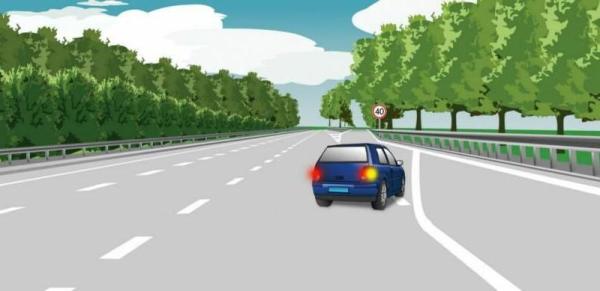
Answer: Y
8. When driving in a heavy rain, the driver should control the speed to avoid the danger arising from water slide.
Answer: Y
9. A motorized vehicle is not allowed to make a U turn at the level crossing, bridge, steep slope, tunnel or dangerous road section.
Answer: Y
10. A motorized vehicle driver is not allowed during the period of probation to pull a trailer.
Answer: Y
11. Speeding up to go though the intersection before the light turns to red in this case.
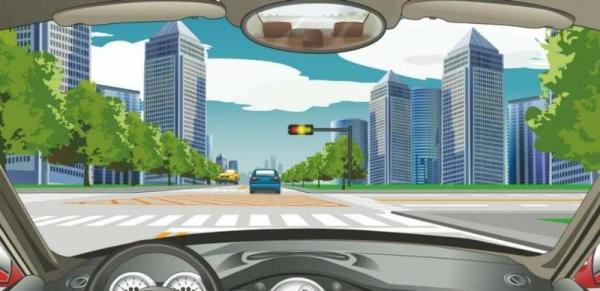
Answer: N
12. At this position, you may speed up to pass through the section.
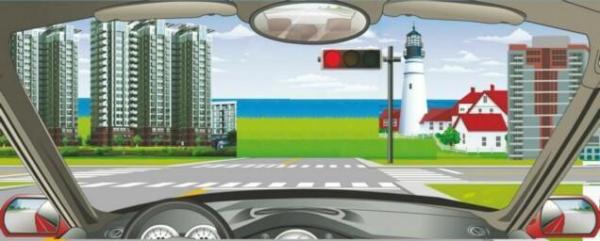
Answer: N
13. When a motorized vehicle passes through narrow road or bridge, the maximum speed should not exceed 30 kilometers per hour.
Answer: Y
14. When driving a vehicle through an inundated road with non-motorized vehicles on both sides, the driver should _________.
A. Reduce speed and go slowly
B. Go forward normally
C. Speed up and pass
D. Continuously honk
Answer: A
15. The main impact of mountain roads on safe driving is _______.
A. The traffic conditions are boring
B. The slopes are long, the curves are sharp and visibility range is shorter.
C. The traffic flow is heavy
D. The road signs are fewer
Answer: B
16. When a motorized vehicle goes at night through an intersection that has no traffic lights, the driver should not use the high and low beam lights alternately.
Answer: N
17. In this case, by the right side of the bus lane to overtake.
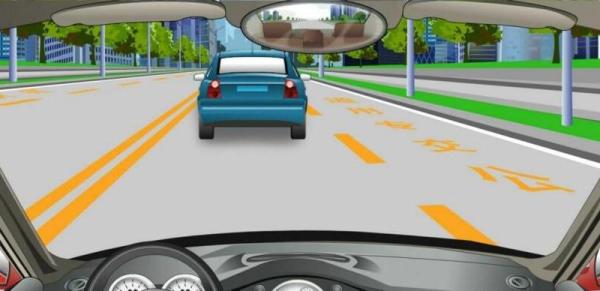
Answer: N
18. When there is a continuous rain, the shoulders of the mountain roads may become loose and the embankments may collapse. When driving in this weather, the driver should select the middle solid road and refrain from going close to the roadsides.
Answer: Y
19. You may speed up to go through the intersection in this case.
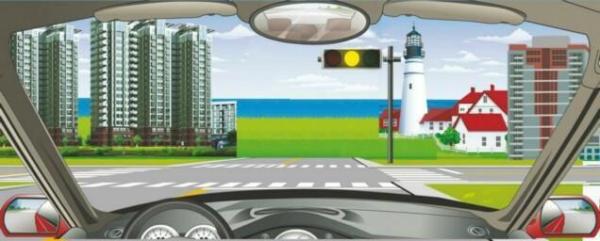
Answer: N
20. Traffic Police can detain the driver according to law, if the driver drives a motorized vehicle which is suspected of reaching the write-off standard.
Answer: N
Previous: 外国人驾照考试题目及答案图片高清
Next: 国外驾照换国内驾照流程新疆