
科目一英语版下载安装手机版最新
2026年科目一英文版题库共973题,你可以免费查看随机20题,完整版题库请添加微信购买:

The English version of the 2026 subject 1 question bank has a total of 973 questions. You can view the top 20 questions for free. Please add WeChat to purchase the complete version of the question bank.
1. If a driving license is obtained by deception, bribery or other illegal means, the driving license should be revoked and the applicant is not allowed to re-apply for it _____ .
A. within 3 years
B. the whole life
C. within 1 year
D. within 5 years
Answer: A
2. When the tire pressure is too low, the fast-running tire can change its shape like waves and increase its temperature, which in turn can cause ________.
A. Even lower tire pressure
B. Increases resistance to the vehicle
C. Tire blowout
D. Unstable tire pressure
Answer: C
3. A motorized vehicle driver who deliberately covered or stained the license plate and placed the license plate unproperly, is subject to a ________.
A. 2-point penalty
B. 3-point penalty
C. 6-point penalty
D. 12-point penalty
Answer: D
4. When overtaking on a mountain road, the vehicle should overtake ______.
A. By taking every possible chance
B. By selecting a wide gentle uphill section
C. By selecting a fairly long downhill section
D. By selecting a relatively gentle downhill section
Answer: B
5. When the green arrow for a lane is on and there are still pedestrians in the crosswalk before the vehicle, the driver should ___________.
A. Directly start up and pass
B. Start up and bypass the pedestrians from behind
C. Start up and bypass before the pedestrians
D. Start up after the pedestrians have passed
Answer: D
6. According to rules on the road traffic safety, the maximum speed on the expressway is less than 120km/hr, thus, it will not be in violation of the traffic regulations as long as the speed does not exceed 120km/hr on the expressway.
Answer: N
7. When a vehicle reaches a sharp curve, the driver should _______.
A. Brake suddenly and go slowly
B. Drive along the outer side of the curve
C. Fully reduce speed and drive on the right side
D. Go forward by borrowing the opposite lane
Answer: C
8. If a motorized vehicle driver has caused a major traffic accident in violation of the traffic regulations which has caused human death due to his escaping, the driver is subject to a prison term of 3 years ~ 7 years.
Answer: N
9. The main impact of the road conditions at night on safe driving is ________.
A. The visibility is low and unfavorable for observing road traffic conditions
B. The road surface is complex and changing
C. The physical strength of the driver decreases
D. The driver can easily have impulse and illusion
Answer: A
10. When driving in a foggy day, the driver should turn on ______.
A. The reverse light
B. The low beam light
C. The fog light
D. The high beam light
Answer: C
11. When driving in a heavy rain, the driver should control the speed to avoid the danger arising from water slide.
Answer: Y
12. In this case, by the right side of the bus lane to overtake.
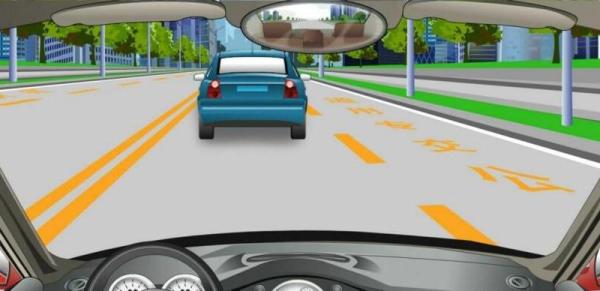
Answer: N
13. When driving a motorized vehicle uphill, you should speed up and honk when you going to reach the top of the slope.
Answer: N
14. If an improper place is chosen for crossing another vehicle, the driver should immediately _______.
A. Reduce speed and cross each other slowly, or stop to yield
B. Occupy the left lane to force the opposite party to reduce speed and yield
C. Turn the head light to indicate the opposite party to stop and yield
D. Speed up and select a better place
Answer: A
15. Stopping temporarily on the road should not obstruct the passing of other vehicles and pedestrians.
Answer: Y
16. When a vehicle has to stop on an expressway due to a vehicle trouble, the driver should place a breakdown warning sign beyond ______ m behind the vehicle.
A. 25
B. 150
C. 100
D. 50
Answer: B
17. It is a bad habit for a driver to put his left arm on the window of the vehicle or hold the gear lever in his right hand for a long time.
Answer: Y
18. When running on the road having maximum speed limit signs, the motorized vehicle is not allowed to exceed the marked maximum speed.
Answer: Y
19. The main impact of muddy roads on safe driving is _________.
A. The resistance to the vehicle becomes weaker
B. The tires can easily spin and skid
C. The visibility become lower and blurs the field of vision
D. The road grip becomes stronger
Answer: B
20. The police can detain the vehicle if one drives a vehicle without ______
A. vehicle license
B. qualification certificate
C. ID card
D. pass paper
Answer: A
Previous: 盘锦外国人考中国驾照英语科目一试题
Next: 遵义外国人考中国驾照英语版