
和田外国人考中国驾照英语科目一试题
2026年科目一英文版题库共973题,你可以免费查看随机20题,完整版题库请添加微信购买:

The English version of the 2026 subject 1 question bank has a total of 973 questions. You can view the top 20 questions for free. Please add WeChat to purchase the complete version of the question bank.
1. If the accumulated penalty points of a motorized vehicle driver reach 12 points and the driver refuses to participate in the study course and also refuses to take tests, it should be publicly announced that his driving license should no longer be used.
Answer: Y
2. When driving in icy and snowy weather, the vehicle steadiness decreases and sudden acceleration can very easily cause spins and slides.
Answer: Y
3. When driving in icy and snowy weather, ________.
A. The braking distance becomes longer
B. The resistance to slide becomes larger
C. The braking performance does not change
D. The road grip becomes stronger
Answer: A
4. When a vehicle stops temporarily in a rainy day, the driver should turn on ______.
A. The head and tail fog lights
B. The hazard lights
C. The high beam light
D. The reverse light
Answer: B
5. A motorized vehicle driver is not allowed during the period of probation to pull a trailer.
Answer: Y
6. When driving in thick or extremely thick fog, the driver should ____ due to low visibility.
A. Turn on the head light and keep driving
B. Turn on the contour light, fog light and drive along the right side
C. Turn on the hazard lights and keep driving
D. Turn on the hazard lights, fog light, and stop at a safe place
Answer: D
7. Traffic Police can detain the vehicle according to law if it is without the mandatory traffic accident insurance in accordance with state regulations.
Answer: Y
8. At night, the drivers observation is markedly poorer than in the daytime and the range of visibility range is _______.
A. Unchanged
B. Irregular
C. Longer
D. Shorter
Answer: D
9. What is the max speed on muddy road?
A. 15km/hr
B. 20km/hr
C. 40km/hr
D. 30km/hr
Answer: D
10. When the green arrow for a lane is on and there are still pedestrians in the crosswalk before the vehicle, the driver should ___________.
A. Directly start up and pass
B. Start up and bypass the pedestrians from behind
C. Start up and bypass before the pedestrians
D. Start up after the pedestrians have passed
Answer: D
11. Motorized vehicles should pass the intersections according to the traffic signals.
Answer: Y
12. When encountering an overflowing bridge, the driver should look at the situation, and passes through slowly before he makes sure that it is safe to do so.
Answer: Y
13. Driving a small passenger vehicle on the expressway, the minimum speed should not be less than 90 kilometers per hour.
Answer: N
14. When driving at night on a road that has good lighting, the driver should use _______.
A. The fog light
B. The low beam light
C. The high beam light
D. The hazard lights
Answer: B
15. When overtaking a vehicle stopping on the right side, the driver should ________ in case that vehicle starts up suddenly or opens the door.
A. Speed up and pass
B. Keep honking
C. Maintain the normal speed
D. Keep a safe horizontal distance from that vehicle, reduce speed and pass
Answer: D
16. When a motorized vehicle breaks down at night, and is difficult to move, the driver should turn on the hazard lights, the contour lights and the tail lights.
Answer: Y
17. When a vehicle coming in the opposite direction suddenly overtakes and occupies your lane, the correct way to deal with this situation is to __________.
A. Obstruct the way of that vehicle
B. Maintain the original speed
C. Reduce speed and avoid as much as possible, till stop
D. Speed up and go forward
Answer: C
18. When encountering children on the road, the driver should _________.
A. Reduce speed and go slowly, or stop to yield when necessary
B. Continuously honk to urge
C. Swiftly bypass from one side
D. Speed up and bypass
Answer: A
19. What kind of behavior of this driver violates the law?
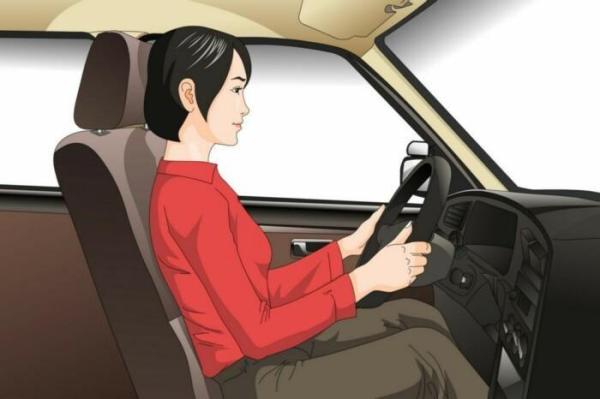
A. not hold the steering wheel according to regulation
B. angle of the seat is not correct
C. not buckled up
D. the driving posture is incorrect
Answer: C
20. What is the max speed when passing this curve?

A. 40km/hr
B. 30km/hr
C. 50km/hr
D. 70km/hr
Answer: B
Previous: 芜湖外国人考中国驾照英语科目一试题
Next: 外籍人士在中国考驾照需要什么条件