
国外驾照换国内驾照流程连云港
2026年科目一英文版题库共973题,你可以免费查看随机20题,完整版题库请添加微信购买:

The English version of the 2026 subject 1 question bank has a total of 973 questions. You can view the top 20 questions for free. Please add WeChat to purchase the complete version of the question bank.
1. When a vehicle goes downhill, it may fully use the neutral gear and slide.
Answer: N
2. When encountering school children crossing the road in a queue, the driver should ______.
A. Speed up in advance and pass forcefully
B. Stop to yield
C. Reduce speed and go slowly
D. Continuously honk to urge them
Answer: B
3. The method of this small passenger vehicle to leave the expressway lane is correct.
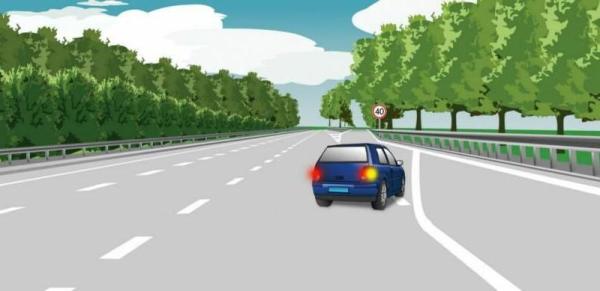
Answer: Y
4. When driving in a foggy day, the driver should turn on ______.
A. The reverse light
B. The low beam light
C. The fog light
D. The high beam light
Answer: C
5. When a tire blows out suddenly on the road, the driver should refrain from violently depressing the brake pedal in panic. Instead, he should try his best to shift the gear to a low position and use the engine braking to reduce the speed of the vehicle.
Answer: Y
6. When driving in windy, rainy, snowy, foggy and other complex weather conditions, the driver should turn on the head light, honk continuously and overtake rapidly if the vehicle in front goes slowly.
Answer: N
7. You can make an U turn at this intersection.
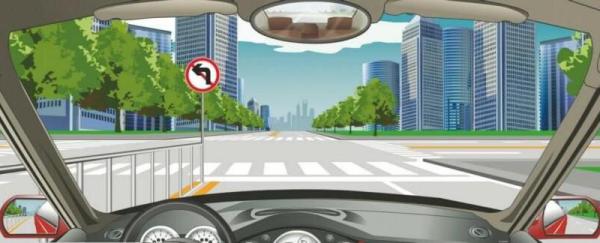
Answer: N
8. When a motorized vehicle breaks down on the expressway, the driver should place a warning sign 50 meters ~ 100 meters in the coming direction.
Answer: N
9. The vehicles should run by the right shoulder of an expressway.
Answer: N
10. When a vehicle follows another vehicle on a mountain road, it should ____.
A. Properly increase the safe distance
B. Closely follow the vehicle in front
C. Properly reduce the safe distance
D. Try to find a chance to overtake
Answer: A
11. When encountering disabled people obstructing the traffic, the driver should voluntarily reduce speed and yield.
Answer: Y
12. When a motorized vehicle passes through narrow road or bridge, the maximum speed should not exceed 30 kilometers per hour.
Answer: Y
13. How to pass this intersection?
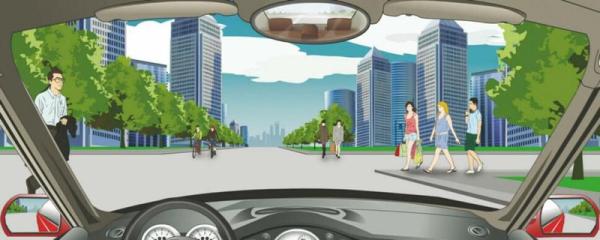
A. keep the speed and go through
B. honk to urge
C. reduce speed and go through slowly
D. speed up and go through
Answer: C
14. Traffic Police can detain the vehicle according to law if it is without the mandatory traffic accident insurance in accordance with state regulations.
Answer: Y
15. When driving in thick or extremely thick fog, the driver should ____ due to low visibility.
A. Turn on the head light and keep driving
B. Turn on the contour light, fog light and drive along the right side
C. Turn on the hazard lights and keep driving
D. Turn on the hazard lights, fog light, and stop at a safe place
Answer: D
16. When a motorized vehicle encounters the cut in by another vehicle in a roundabout, the driver may not evade as long as he has the right of way.
Answer: N
17. How far should be the distance from the vehicle in front at the speed of more than 100 km/hr when driving a small passenger vehicle on the expressway?
A. more than 50 meters
B. more than 60 meters
C. more than 100 meters
D. more than 80 meters
Answer: C
18. If a front tire blowout has caused a turn in direction, the driver should not avoid excess adjustment. Instead, he should control the direction of the vehicle, ____, and slowly reduce the speed of the vehicle.
A. Apply emergency braking
B. Use the handbrake
C. Gently depress the brake pedal
D. Swiftly depress the brake pedal
Answer: C
19. When a vehicle passes a bumped road, the driver should ________.
A. Speed up and dash over under inertia
B. Change to the neutral gear and slide over
C. Maintain the original speed and pass
D. Pass slowly and steadily
Answer: D
20. When a vehicle is being overtaken by another vehicle, the driver should _____.
A. Run by the central line of the road
B. Speed up and yield
C. Continue to speed up and run
D. Reduce speed and run on the right side
Answer: D
Previous: 科目一英文版题目大全图片
Next: 山东外国人考中国驾照英语版