
国外驾照换国内驾照流程昌都
2026年科目一英文版题库共973题,你可以免费查看随机20题,完整版题库请添加微信购买:

The English version of the 2026 subject 1 question bank has a total of 973 questions. You can view the top 20 questions for free. Please add WeChat to purchase the complete version of the question bank.
1. Motorized vehicles should pass the intersections according to the traffic signals.
Answer: Y
2. A motorized vehicle driver is not allowed during the period of probation to pull a trailer.
Answer: Y
3. If a vehicle enters a left lane for overtaking but is unable to ensure a safe horizontal distance with the normally-running vehicle in front, the driver should ________.
A. Speed up and overtake
B. Overtake after running a distance in parallel
C. Give up overtaking
D. Overtake with care
Answer: C
4. When a vehicle changes to the right lane, the driver should turn on the right-turn signal in advance, observe and enter the new lane if it is safe to do so.
Answer: Y
5. The main feature of pedestrians participating in road traffic is that _________.
A. They move slowly
B. They like to get together and look on
C. They walk around at will and can easily change directions
D. All the above
Answer: C
6. When the green light at a congested intersection is on, the vehicles _______.
A. May directly enter the intersection
B. Cannot enter the intersection
C. May pass the intersection by borrowing the opposite lane
D. Enter the intersection if it is safe to do so
Answer: B
7. How to do when causing a minor traffic accident with no human casualties and no dispute?
A. do not move the vehicle
B. counsel other vehicles bypass
C. leave the scene and discuss on their own
D. protect the scene and discuss
Answer: C
8. Traffic Police can detain the vehicle according to law if it is without the mandatory traffic accident insurance in accordance with state regulations.
Answer: Y
9. If the accumulated penalty points of a motorized vehicle driver reach 12 points and the driver refuses to participate in the study course and also refuses to take tests, it should be publicly announced that his driving license should no longer be used.
Answer: Y
10. Driving a motorized vehicle on the road should be required to be with a license plate.
Answer: Y
11. What is the max speed when down slope, turning around and U turn?
A. 50km/hr
B. 60km/hr
C. 30km/hr
D. 40km/hr
Answer: C
12. When discovering the persons injured in a traffic accident need rescue while driving, the driver should _________.
A. Send the injured persons to hospital in a timely manner or make emergency calls
B. Dodge as much as possible
C. Go ahead by bypassing the scene
D. Find an excuse to dodge the scene
Answer: A
13. When a vehicle wades across the water, the driver should maintain a low speed, and _____ the brake pedal so as to restore the braking efficiency.
A. Continuously and strongly depress
B. Intermittently and strongly depress
C. Continuously and gently depress
D. Intermittently and gently depress
Answer: D
14. If a driver has not received full penalty points, and the fine has not been paid, the penalty points will be transferred into the next scoring cycle.
Answer: Y
15. When encountering an overflowing bridge, the driver should look at the situation, and passes through slowly before he makes sure that it is safe to do so.
Answer: Y
16. Stop the vehicle and observe when reaching the level crossing in this situation.
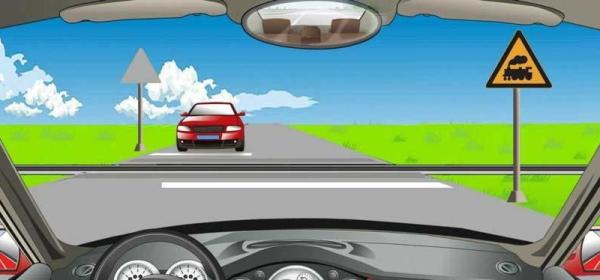
Answer: Y
17. When driving at night, the drivers visibility range becomes shorter and his observation becomes poorer. At the same time, the driver can easily become tired because he has to highly concentrate his attention.
Answer: Y
18. If a front tire blowout has caused a turn in direction, the driver should not avoid excess adjustment. Instead, he should control the direction of the vehicle, ____, and slowly reduce the speed of the vehicle.
A. Apply emergency braking
B. Use the handbrake
C. Gently depress the brake pedal
D. Swiftly depress the brake pedal
Answer: C
19. When the vehicles cross each other at night, the driver may continuous change lights to remind the vehicle coming in the opposite direction and at the same should reduce speed and go forward or stop on the right side.
Answer: Y
20. You can drive a motorized vehicle a short distance after drinking as long as it does not interfere the driving operation.
Answer: N
Previous: 海西驾考英文版科目一试题
Next: 成都外国驾照换中国驾照需要什么条件